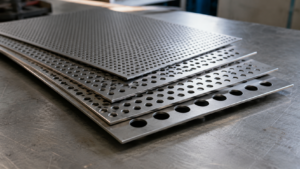
If you have ever opened a fresh delivery of perforated sheet and felt that something was slightly off, you were probably right. The holes looked close enough, the pattern seemed fine, and yet the parts did not seat the way they should. Nine times out of ten, the culprit is hole tolerance, the single spec that quietly separates a careful supplier from one that is cutting corners.
Hole tolerance rarely makes it into the sales conversation. Buyers ask about material grade, thickness, and price, then assume the holes will land where the drawing says. They usually do, until they do not, and by then the sheet is on your floor and the project clock is running. This guide walks through seven signs that your supplier is loosening their standards, plus a simple way to verify quality before you accept a batch.
Why hole tolerance matters more than buyers think
Hole tolerance is the allowable variation in how a punched hole is made: its diameter, its spacing from the next hole, and its position relative to the sheet edge. A tight tolerance means every hole sits where it is supposed to, within a small fraction of a millimetre. A loose one means the holes wander, and that wandering compounds across a large sheet.
This matters because a perforated sheet almost never works alone. It bolts into a frame, stacks against a gasket, sits in a filter housing, or aligns with a second panel. When the holes drift, fitment fails, airflow calculations stop matching reality, and filtration performance becomes a guess rather than a spec.
A reputable perforated sheet supplier treats tolerance as a promise, not a suggestion. When that promise slips, the warning signs below start to appear.
Sign 1: Inconsistent hole diameter across the sheet
The most basic test of a perforated sheet is whether every hole is the same size. Worn or poorly maintained tooling produces holes that start at the correct diameter and gradually shrink or widen as the punch dulls.
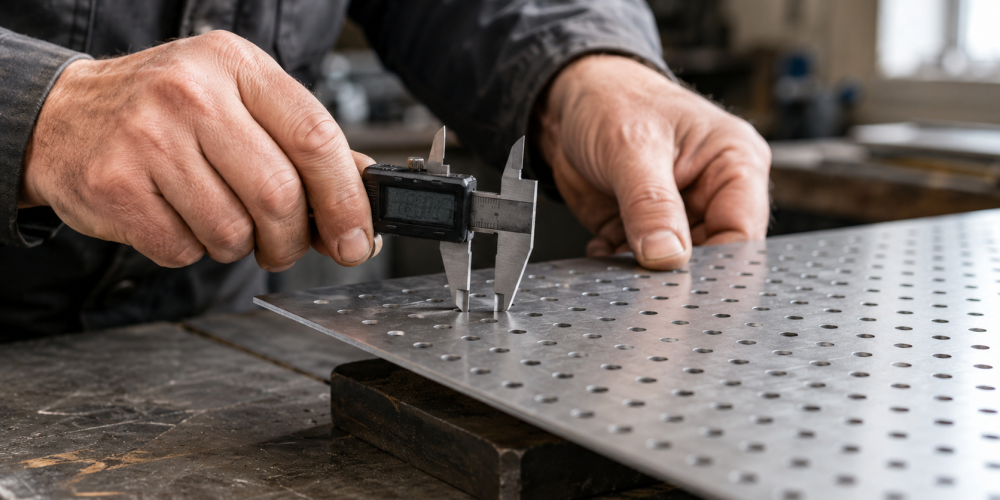
Check several holes from different areas of the sheet with a pin gauge or caliper. If you find noticeable variation between the centre and the edges, the supplier is either running tired tooling or skipping inline checks. Both point to corners being cut.
The reason this happens is simple economics. Tooling is expensive, and replacing a punch and die set before the end of its run costs money. A disciplined shop measures hole size at the start, middle, and end of every batch and pulls worn tooling the moment readings drift. A shop under pressure to hit a price keeps running until the numbers are clearly out, and your sheet is the one that pays for it. When diameter varies, downstream parts that depend on a press fit or a slip fit stop behaving predictably, and you end up sorting good holes from bad by hand.
Sign 2: Drifting pitch and misaligned hole patterns
Pitch is the centre-to-centre distance between holes. On a quality sheet, that distance is uniform in every direction. On a poorly controlled one, the pattern slowly drifts, so holes near one edge no longer line up with a mating part.
You can spot pitch drift by laying a straightedge along a row of holes. If the row bows or the spacing visibly opens up toward one end, the feed system was not properly calibrated. For anything that has to align with another component, this is a serious problem.
Sign 3: Burrs, taper, and rough hole walls
A clean hole has crisp edges and a straight wall. A rushed one shows burrs on the exit side, a tapered profile, or a torn, ragged edge. Burrs are not just cosmetic. They snag during assembly, cut hands, trap debris, and interfere with coatings.
Run a fingertip lightly across the back of the sheet. Heavy burring usually means the punch-to-die clearance is wrong or the tooling is overdue for replacement. A careful supplier deburrs as part of the process rather than passing the cost and the hazard on to you.
Sign 4: No tolerance spec on the quote or datasheet
Here is one of the clearest tells. A trustworthy supplier states hole tolerance in writing, on the quote, the drawing, or the datasheet. A supplier cutting corners stays vague and hopes you will not ask.
What a proper tolerance callout should look like
A clear specification names the nominal hole diameter, the allowable plus or minus variation, the pitch tolerance, and the relevant standard it follows. If you ask for these numbers and the answer is “they will be fine” rather than an actual figure, treat that as a red flag in itself.
Sign 5: Excessive sheet warping or pillowing near edges
Punching removes a lot of material, and that releases stress in the metal. Some flatness deviation is normal, but heavy waviness, pillowing between holes, or curling at the edges means the supplier skipped the leveling or flattening step.
Lay the sheet on a known flat surface and look for rocking or gaps underneath. A sheet that will not sit flat will not mount flat, and no amount of tightening fixes a panel that fights its own frame.
Flatness becomes more critical as sheets get larger and open area increases. A small sheet with modest perforation hides minor stress well, but a large architectural panel with high open area will telegraph every shortcut. Quality suppliers run finished sheets through a roller leveler or a stretch-flattening step precisely because they know punching distorts the metal. If a quote comes in surprisingly cheap, ask whether leveling is included. The savings often come from skipping exactly this step, and you discover the omission only when the panels arrive and refuse to sit true against the wall.
Sign 6: Tooling marks and worn-punch evidence
Look closely at the surface around the holes. Scoring, scratches radiating from each hole, or a smeared appearance on the punched face are signs of worn tooling or inadequate lubrication. Fresh, sharp tooling leaves clean entry and exit points.
These marks tell you the supplier is pushing tooling past its service life to save money. The same worn punches that leave cosmetic marks are also the ones drifting out of dimensional tolerance, so this sign rarely travels alone.
Lubrication plays a role here too. Punching steel or stainless without adequate lubricant generates heat and friction that scar the surface and accelerate tooling wear. A shop that skimps on coolant to cut costs leaves a trail of evidence on every sheet. If you see consistent radial scoring around holes across an entire delivery, it is not a one-off bad sheet. It is a process running outside its proper limits, and the dimensional problems are simply harder to see than the cosmetic ones.
Sign 7: Vague or missing inspection reports
Quality that is not measured is quality that is hoped for. A supplier that controls hole tolerance can show you how they check it, batch by batch.
Questions to ask for documented QC
- Do you provide a dimensional inspection report with each batch?
- How often do you gauge holes during a production run?
- Which tolerance standard do you certify against?
If these questions are met with hesitation, the controls probably do not exist. This is worth raising early, especially when you are comparing a perforated sheet supplier in Coimbatore against quotes from elsewhere, since documentation is one of the easiest ways to compare two vendors fairly.
How to verify hole tolerance before you accept a batch
You do not need a metrology lab to protect yourself. A few minutes with simple tools catches most problems:
- Gauge the diameter of five to ten holes from different zones of the sheet and compare them.
- Check the pitch with a caliper or a straightedge across several rows.
- Feel for burrs on both faces, paying attention to the exit side.
- Test flatness on a level surface and watch for rocking or curl.
- Request the inspection report and confirm it lists actual measured values, not just a pass stamp.
If you are sourcing locally, the same checks apply whether you are buying perforated sheet in Coimbatore or shipping it across the country. Searching for perforated sheet suppliers near me will surface plenty of names, but only the measurements tell you which ones deserve your order.
Hole tolerance is the spec nobody brags about and everybody depends on. A supplier who controls it will show you the numbers without flinching. A supplier cutting corners will rely on the fact that most buyers never check. Now that you know the seven signs, you are no longer most buyers. Measure first, commit second, and let the calipers, not the sales pitch, decide who earns your next order. Contact Sudharsun Traders.