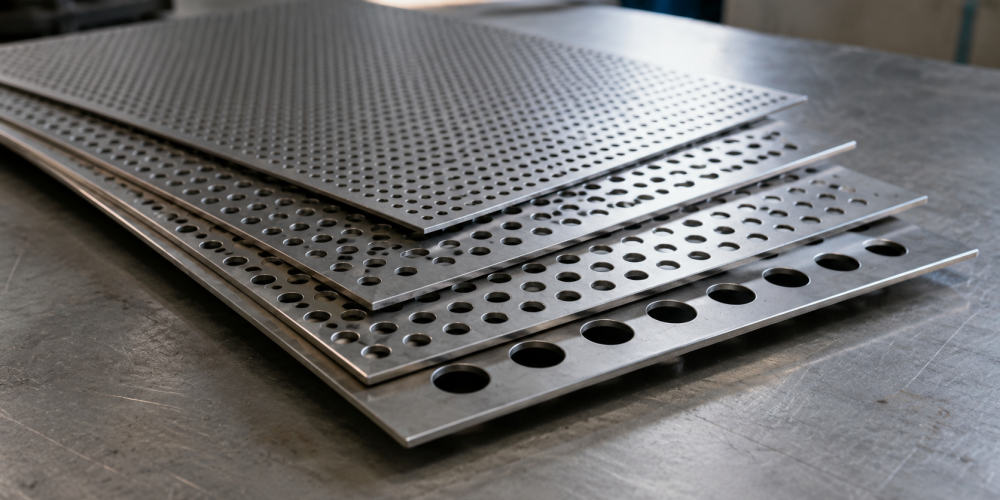
Two perforated metal sheets can sit side by side, look almost identical, and behave completely differently the moment you put them to work as a filter. One lets the right flow through and traps what it should. The other clogs, leaks the wrong particles, or chokes the system it was meant to protect. The difference is never in how the sheet looks. It is in the specification.
When people choose a sheet for a filter, they tend to glance at hole size and price, then move on. That is how filters end up underperforming. A perforated sheet is a precision component, and at least eight separate specs decide whether it does its job. Miss one and the whole assembly suffers. This guide walks through all eight, in plain language, so you can specify with intent instead of hoping the sheet you ordered happens to fit the task.
How a perforated metal sheet actually works as a filter
A filter has one job: let the wanted material pass while holding back the unwanted. A perforated sheet does this through the size, shape, and arrangement of its holes, plus the strength and finish of the metal around them. Get those right and the sheet separates cleanly. Get them wrong and it either blocks flow or lets the wrong things through.
Filtration versus simple screening
It helps to know which job you actually have. Screening separates coarse material, like keeping stones out of gravel. True filtration captures finer particles and usually has tighter tolerances, higher pressure, and stricter flow targets. Many buyers specify a screening sheet for a filtration job and then wonder why performance falls short. Knowing which side of that line you are on shapes every spec that follows.
Spec 1: Hole diameter and the particle size it captures
Hole diameter is the headline spec because it sets the cutoff point. Anything larger than the hole is held back, anything smaller passes through. If your filter has to stop particles above a certain size, the hole diameter is your first and most important decision.
The mistake is choosing by eye. A hole that looks small enough may still be well above the particle size you need to capture. Match the diameter to the actual particle dimension you are filtering, and confirm the supplier holds that diameter consistently across the whole sheet.
It also helps to think in terms of the smallest particle, not the average one. If your process produces a range of particle sizes, the filter has to stop the smallest unwanted particle, which means sizing the hole to that figure rather than to a comfortable middle value. Many filters disappoint simply because the diameter was chosen for the typical particle and quietly passed everything finer than expected.
Spec 2: Open area percentage and flow rate
Open area is the proportion of the sheet that is actually holes rather than solid metal. It directly controls how much fluid or air can pass through for a given pressure. A high open area means generous flow and low resistance. A low open area restricts flow and raises the pressure drop across the filter.
This spec is a balancing act. Smaller holes capture finer particles but reduce open area, which throttles flow. Larger holes flow freely but capture less. Choosing a filter sheet means deciding where on that trade-off your application needs to sit, then holding to it.
Open area also affects how the filter ages. A sheet with generous open area has more total flow path, so as some holes begin to blind with trapped material, the remaining holes keep the system breathing for longer. A sheet that started with barely enough open area reaches a critical pressure drop much sooner, because it had no spare capacity to begin with. When you size open area, leave a sensible margin for the gradual clogging that every real filter experiences in service.
Spec 3: Hole pattern and pitch
Pattern describes how the holes are arranged, commonly a staggered or a straight-line layout. Pitch is the centre-to-centre distance between them. Together they influence open area, strength, and how evenly flow distributes across the surface.
- A staggered pattern usually packs more holes into the same area, raising open area.
- A straight pattern can be easier to align with other components.
- Tighter pitch increases open area but leaves less metal between holes, which lowers strength.
For a filter under pressure, an even pattern matters because it spreads load and flow uniformly instead of concentrating stress in one zone.
Spec 4: Material grade and corrosion resistance
The best hole geometry is useless if the metal degrades in service. Material grade decides whether the sheet survives its environment. A filter in clean dry air can use a basic grade. A filter handling moisture, chemicals, food, or saltwater needs stainless steel of an appropriate grade, often 304 or 316.
Corrosion does not just shorten the sheet’s life. As the metal pits and roughens, hole dimensions change, particles snag, and filtration performance drifts away from spec. Picking the right grade up front protects both durability and accuracy. This is also where talking to experienced perforated metal sheet manufacturers pays off, since they can match grade to environment rather than selling you whatever is in stock.
Spec 5: Sheet thickness and structural strength
Thickness determines how much pressure the sheet can take before it deforms. A filter that flexes or bows under flow changes its own geometry, which ruins consistency and can tear at the holes. Thicker sheets resist this but cost more and can be harder to perforate with very small holes.
The right thickness depends on hole size, open area, and the pressure the filter will see. A thin sheet with high open area is fragile. A thick sheet with tiny holes can be difficult to manufacture cleanly. The goal is the thinnest sheet that still holds its shape reliably under your working pressure.
Spec 6: Hole shape: round, slotted, or square
Round holes are the default and suit most filtration jobs because they balance strength and flow well. But shape is a real variable. Slotted holes can pass elongated particles and shed certain materials better. Square holes maximise open area for a given dimension.
The shape changes how particles approach and pass the opening, so it affects both capture and clogging. For sticky or fibrous materials, the wrong hole shape blinds over quickly and the filter stops working long before it should. Matching shape to the material being filtered is an underrated decision.
Spec 7: Burr-free finish and edge quality
A clean hole filters predictably. A hole ringed with burrs does not. Burrs and rough hole walls snag particles, create turbulence, accelerate clogging, and can contaminate the very flow the filter is meant to clean. In food, pharmaceutical, or fine-fluid applications, a rough finish is a genuine fault, not a cosmetic one.
A quality sheet is deburred and finished so the holes are crisp on both faces. When you inspect a sample, run a finger across the back and look at the hole walls. Smooth, sharp-edged holes are a sign the sheet will filter the way its specs promise.
Spec 8: Hole tolerance and consistency
Finally, every hole has to match its specification, not just the average hole. Hole tolerance is the allowable variation in diameter and position. Loose tolerance means some holes are larger than intended, and those oversized holes let through exactly the particles you were trying to stop.
A filter is only as good as its worst hole. One batch of inconsistent perforations can undermine an otherwise perfect specification. Ask any supplier how tightly they hold tolerance and whether they can show measured values, because consistency is what turns a good design into a filter that actually performs.
Matching perforated metal sheets to your filtration job
You do not weigh all eight specs equally every time. The application decides which ones lead. A quick way to approach it:
- Define the particle size you must capture first; this sets hole diameter.
- Set your flow target, which drives open area and pitch.
- Identify the environment to choose material grade and corrosion resistance.
- Estimate the working pressure to settle thickness.
- Consider the material’s behaviour, sticky or fibrous, to pick hole shape.
- Insist on finish and tolerance so the sheet performs as specified.
If you are searching for a perforated metal sheet near me or comparing perforated metal sheets for sale online, take this list with you. The supplier who can answer all six points confidently is the one whose sheets will actually work in your filter.
A perforated sheet is easy to underestimate. It looks like a panel with holes, yet eight separate decisions stand between it and a filter that performs. Hole size, open area, pattern, material, thickness, shape, finish, and tolerance each carry weight, and the cheapest sheet is rarely the one that gets them all right. Specify deliberately, ask for measured numbers, and you stop gambling on appearance. The holes you cannot see clearly are the ones that decide whether your filter works at all. Contact Sudharsun Traders