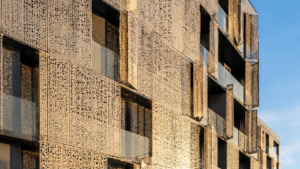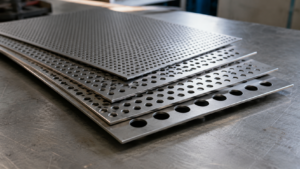
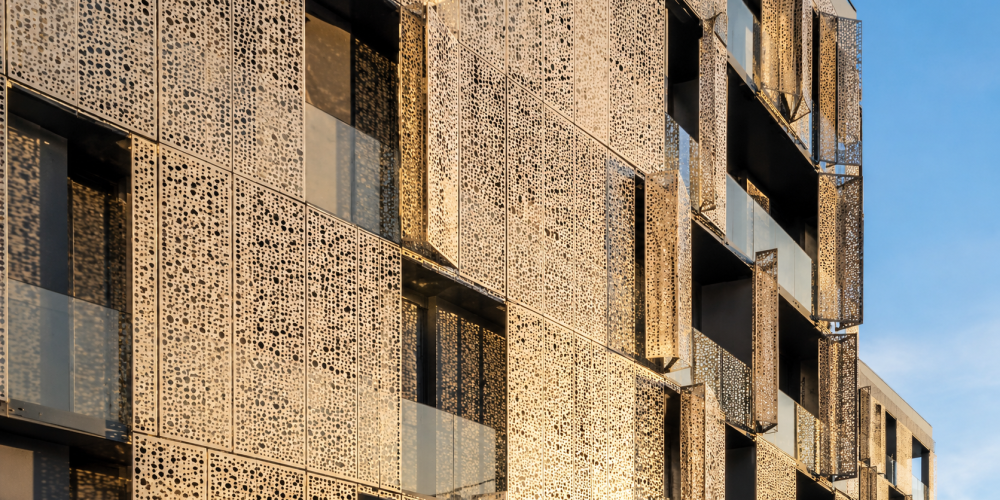
A perforated metal facade is one of those design moves that looks effortless in the final render and punishes in the field when something was missed. The panels glow, the pattern reads cleanly, the building feels light. Then the real sheets arrive, and the daylight is wrong, the panels oil-can in the wind, or the pattern shimmers in a way nobody intended. The facade was never the problem. The specification was.
Perforated metal sheets reward careful thinking and expose shortcuts. Architects work with them confidently for their look, yet the details that decide whether a facade succeeds often sit outside the rendering: open area behaviour, viewing distance, wind load, corrosion, fabrication limits, and maintenance. This guide walks through six mistakes that show up again and again on facade projects, and how to avoid each one before it reaches the site.
Why perforated metal sheets are easy to get wrong on a facade
A perforated facade is judged from two distances at once. From across the street it is a texture and a tone. From a metre away it is a grid of real holes in real metal that has to carry load, shed water, and survive weather for decades. Designers naturally fixate on the far view, because that is what the render sells, and the near-view engineering quietly decides whether the far view ever gets built as imagined.
The gap between the render and the built panel
Rendering software treats perforation as a texture or an opacity map. It does not enforce minimum margins, panel rigidity, or how the pattern interacts with the eye at distance. So a facade can look perfect on screen and still be unbuildable, or buildable but disappointing. Closing that gap means specifying the sheet as a physical component, not an image. The six mistakes below are where the gap usually opens up.
Mistake 1: Choosing open area for looks instead of performance
Open area, the percentage of the sheet that is holes, is usually chosen because a render looks right at a particular value. But open area is a performance setting, not just an aesthetic one. It governs daylight, glare, solar shading, privacy, and how much wind passes through rather than pushing against the panel.
When open area is picked purely by eye, the consequences land later:
- Too open, and the facade fails to provide the shading or privacy it was meant to.
- Too closed, and interiors go dark and wind load on the panels climbs sharply.
The fix is to define what the facade must do, control glare, cut solar gain, screen a car park, then choose open area to meet that, and confirm the look second.
Mistake 2: Ignoring viewing distance and the moiré effect
A perforation pattern does not read the same up close as it does from across a plaza. From a distance, fine holes blur into a flat tone, while a coarse pattern stays legible. Architects often design the pattern at screen scale and forget that the real building is seen mostly from far away, where the carefully chosen pattern simply disappears into grey.
There is a sharper version of this mistake: the moiré effect. When a perforated layer sits in front of another repetitive element, a second skin over windows, railings, or a structural grid, the two patterns can interfere and create shimmering bands that move as you walk past. It is distracting and almost impossible to fix after installation. Checking the pattern against viewing distance, and against anything behind it, prevents both problems.
Mistake 3: Underestimating wind load and panel rigidity
A perforated sheet is weaker than a solid one of the same thickness, because every hole removes material. On a facade, that matters enormously. Wind load tries to bend and flutter the panel, and an undersized sheet will visibly ripple, a defect installers call oil-canning, or worse, fatigue at its fixings over time.
The mistake is specifying thickness and panel size from appearance or from a solid-sheet rule of thumb, ignoring how perforation and open area reduce stiffness. The correct approach accounts for panel span, fixing method, open area, and the local wind environment together. A facade that looked elegant on paper can become a maintenance liability if the panels were never sized for the wind they actually face.
Taller buildings make this worse, because wind pressure rises with height and corners see the strongest gusts. A panel size that behaves at the second floor can flutter near the top of the same building. The fixing system also carries the load the perforation no longer can, so bracket spacing and edge stiffening matter as much as the sheet. Treating the panel, its frame, and its fixings as one structural decision keeps a large perforated facade flat and quiet in a storm.
Mistake 4: Overlooking material grade and corrosion in the facade environment
Facades live outdoors for decades, and the environment is unforgiving. A coastal site brings salt, an industrial one brings pollutants, and both attack the wrong material quickly. Choosing a grade for cost or availability rather than exposure is a mistake that surfaces as streaking, staining, and pitting a few years in.
Material choice also interacts with the holes themselves. Cut edges around each perforation are more vulnerable to corrosion than a flat surface, so the finish and grade matter even more on a perforated sheet than a solid one. Aluminium with a quality coating, or an appropriate stainless grade, is specified not just for the face but for the long cut perimeter inside every hole. Architectural perforated metal earns its lifespan from this decision, and skipping it shortens the facade’s life regardless of how good the design looked.
Mistake 5: Forgetting fabrication limits and margin zones
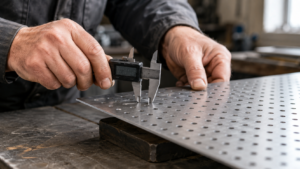
Drawings frequently show perforation running edge to edge across a panel, because that is what looks clean. Fabrication reality is different. Punching needs a solid margin around the sheet edges and around any fixing, bend, or cutout, both for strength and for the tooling to work. Ignore this and the fabricator has to redesign the panel, which changes the very look the architect approved.
What fabricators need that drawings often omit
A buildable perforated panel usually has to define a few things the render leaves out:
- A clear unperforated margin at panel edges and around fixings.
- Sensible end and side distances so holes are not cut through by a bend or trim.
- Pattern alignment across adjacent panels, so the facade reads as continuous rather than visibly seamed.
Settling these with the fabricator early, rather than after the drawings are issued, keeps the built facade faithful to the design.
Mistake 6: Neglecting maintenance, drainage, and cleaning access
A facade is not finished when it is installed; it has to be cleaned and maintained for its whole life. Perforated metal cladding traps dust, leaves, and water in and behind its holes, and if the design ignores this, the facade stains, streaks, and corrodes faster than anyone expected. Water that cannot drain sits in the perforations and works on the cut edges.
The mistake is treating the facade as a finished image rather than a serviceable system. Good detailing plans for drainage behind the panels, avoids creating ledges where debris collects, and leaves a way to access and clean the surface. A perforated facade that nobody can reach to clean ages badly, no matter how striking it looked on opening day.
The cleaning method matters too, and it is rarely considered at design stage. Some perforation patterns and coatings tolerate pressure washing; others streak or dent under it. If the panels sit as a second skin away from the wall behind, that cavity needs to be reachable or self-draining, because trapped debris in a damp cavity is where corrosion and staining begin. The architects who get this right ask a simple question early: in ten years, who cleans this facade, how do they reach it, and where does the water go? Answering it on the drawing board costs nothing and saves the building’s appearance.
How architects can specify perforated metal sheets correctly
The six mistakes share a root cause: designing the image and assuming the physical sheet will follow. Reverse that, and most problems disappear:
- Start with function: define shading, privacy, daylight, and ventilation targets, then set open areas to meet them.
- Test the pattern at real viewing distance, and check it against anything repetitive behind it for moiré.
- Size panels for wind, accounting for open area, span, and fixings, not solid-sheet assumptions.
- Match material grade and finish to the exposure, remembering the cut edges inside every hole.
- Agree margins, fixings, and pattern alignment with the fabricator before issuing drawings.
- Detail for drainage, debris, and cleaning access so the facade ages well.
Run perforated metal sheets through this checklist and the render and the building finally agree.
A perforated facade is a quiet test of how completely an architect thinks. The look is the easy part; the holes, the wind, the weather, and the maintenance are where projects are won or lost. None of these six mistakes is exotic, and none is hard to avoid once you know to look for it. Specify the sheet as a real, load-bearing, weather-facing component, settle the awkward details before they reach the site, and the facade you imagined is the one that actually gets built. Contact Sudharsun Traders