Walk through any factory floor, construction site, or even a modern office building and you will find a perforated metal plate doing quiet, dependable work somewhere nearby. It filters. It supports. It separates. It ventilates. And through all of this, it holds its shape without complaint. But have you ever stopped to wonder what actually gives these plates their strength? Why do some last for decades while others start showing wear within months? The answer lies in a combination of smart material choices, precise manufacturing methods, and a few engineering principles that most people never think about.
This guide breaks all of that down in plain language. Whether you are buying your first batch of perforated plates or looking to upgrade the quality you currently use, this will help you make a better, more informed decision.
The Foundation – Material Selection
Every strong perforated metal plate starts with the right base material. The metal you choose shapes almost everything else, from how well it handles weight to how long it survives in harsh conditions.
Mild Steel
Mild steel is the most commonly used material for perforated plates. It offers a solid combination of strength and affordability. It handles heavy loads well, and it can be galvanised or painted to resist rust. If your application involves dry or indoor environments with moderate loads, mild steel perforated plates are a reliable and cost-effective option.
Stainless Steel
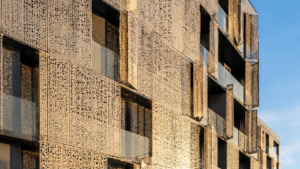
When durability in harsh or wet environments is the priority, stainless steel takes over. It resists corrosion naturally because of its chromium content, which creates a protective layer on the surface. This makes stainless steel perforated metal plates ideal for food processing, chemical plants, marine environments, and anywhere moisture is a constant factor. They also have a cleaner appearance, which matters in architectural and commercial applications.
Aluminium
Aluminium perforated plates are lightweight but surprisingly strong for their weight. They do not rust, making them a natural fit for outdoor use. You will often find aluminium plates used in signage, decorative panels, and applications where the structure needs to stay light without sacrificing too much strength.
Galvanised Steel
Galvanised steel is mild steel that has been coated with zinc. This zinc layer acts as a barrier, protecting the steel underneath from moisture and oxidation. It extends the life of the plate significantly, especially in outdoor or semi-outdoor settings. Perforated metal plates in Coimbatore for industrial outdoor use often rely on galvanised steel for this very reason.
The Role of Perforation Pattern in Strength
Here is something that surprises many buyers. The pattern of holes punched into the plate is not just an aesthetic or functional choice. It directly affects the structural strength of the plate.
Open Area Percentage
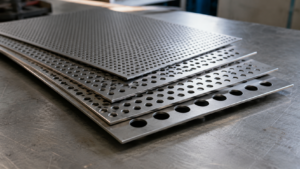
Every perforation pattern has what engineers call an open area percentage. This refers to how much of the plate’s surface has been removed by the holes. A plate with a very high open area percentage, say 60 percent or more, has more material removed. This naturally reduces its load-bearing capacity. On the other hand, a lower open area percentage means more material remains, which means the plate retains more of its original strength.
Finding the right balance is key. Too few perforations and you lose the benefits of airflow, filtering, or drainage. Too many and the plate becomes structurally weaker than your application demands.
Hole Shape and Arrangement
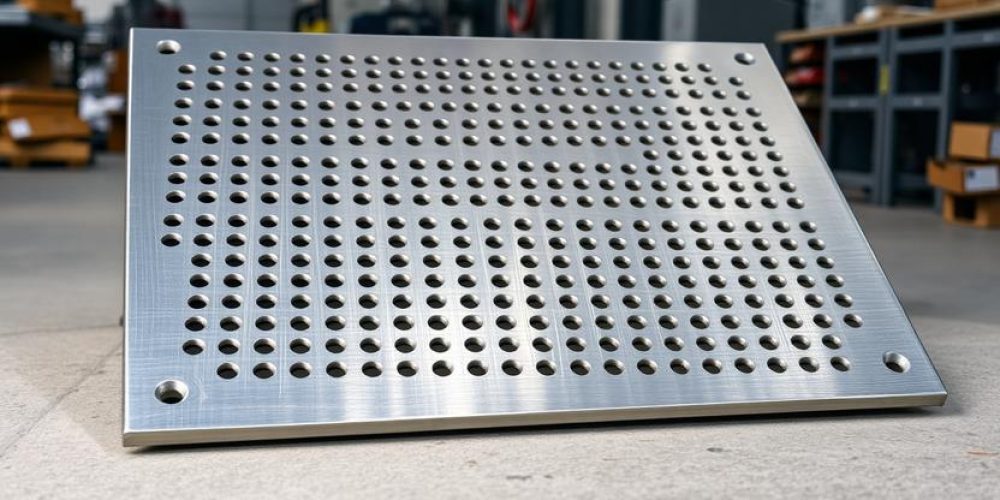
Round holes are the most common because they distribute stress evenly in all directions. This even stress distribution is why round-hole perforated plates tend to be stronger and more durable under repeated load. Square holes and slotted perforations are also used, but they require more careful design to avoid stress concentrations at the corners of the holes.
The arrangement of holes also plays a role. A staggered or offset pattern typically provides better structural integrity than a straight-row pattern, because the material between the holes forms a more continuous and interconnected structure.
Bridge Width
The bridge is the material that remains between two adjacent holes. A wider bridge means more material is left intact, which directly contributes to the plate’s strength. When custom ordering perforated plates, experienced manufacturers will recommend the right bridge width for your specific load requirements.
Plate Thickness – More Than Just Weight
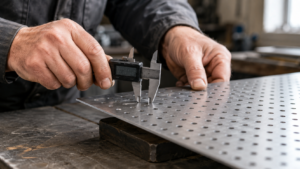
Plate thickness is one of the most straightforward factors in determining strength, but it is often underestimated. A thicker plate can handle more load, resist bending, and withstand impact much better than a thin one. However, thickness must be chosen in relation to the perforation pattern. A thicker plate with a very high open area might still be weaker than a thinner plate with minimal perforation.
For heavy-duty industrial applications like conveyor systems, machine guarding, or load-bearing platforms, thicker perforated metal plates are always the smarter choice. For decorative panels or lightweight filtration applications, thinner plates perform perfectly well and reduce both weight and cost.
The Manufacturing Process Makes a Difference
The way a perforated plate is made has a direct impact on its long-term durability. Two of the most common manufacturing methods are punch pressing and laser cutting, and each has its strengths.
Punch Pressing
This is the traditional and most widely used method for making perforated plates. A machine presses a hardened die through the metal sheet repeatedly to create the holes. When done correctly, punch pressing creates clean holes with smooth edges and minimal material stress. The speed and efficiency of this process also keeps production costs reasonable, which is why punched perforated plates remain the industry standard for most applications.
Laser Cutting
Laser cutting offers greater precision and the ability to cut very intricate patterns. It is particularly useful when working with harder materials or when the design requires unusual hole shapes. However, the heat generated by laser cutting can sometimes affect the material at the edges of the holes. This is why skilled manufacturers monitor cut quality closely, especially when the plate will be used in high-stress applications.
Finishing and Coating
After perforation, the surface treatment applied to the plate has a massive impact on how long it lasts. A powder-coated finish adds both colour and a tough protective layer. Galvanising adds zinc protection. Anodising is used on aluminium plates to increase surface hardness. These finishes act as the plate’s first line of defence against corrosion, abrasion, and the elements.
Skipping proper finishing to cut costs is one of the most common reasons perforated plates fail prematurely. Do not underestimate its importance.
Edge Treatment and Framing
The edges of a perforated plate are often its most vulnerable points. Unfinished edges are sharp, prone to corrosion, and can become starting points for cracks under repeated stress. A quality manufacturer will offer options like folded edges, rounded edges, or framing to reinforce the perimeter of the plate.
Framing involves welding or folding a solid border around the perforated section. This dramatically increases the plate’s rigidity and resistance to bending. It also makes installation safer and easier. For platforms, walkways, and industrial screens, framed perforated plates are almost always the better choice.
Load Conditions and Application Matters
Even the strongest perforated plate will fail early if it is used in the wrong application. Understanding the load conditions your plate will face is essential before choosing specifications.
Static loads, like the weight of a pile of material sitting on a platform, are more predictable and easier to design for. Dynamic loads, like vibration from machinery or repeated impact, are harder on the material. A plate designed only for static loads may crack or deform much sooner than expected when exposed to dynamic conditions.
Similarly, chemical exposure is often overlooked. If your plates will be regularly exposed to acids, alkalis, or cleaning chemicals, the base material and surface coating must be chosen accordingly. A mild steel plate that works perfectly in a dry warehouse will corrode quickly in a chemical processing environment.
Why Perforated Metal Plates in Coimbatore Are Built for Industrial Demands
Coimbatore has long been a hub of textile, engineering, and manufacturing industries. The industrial demands in this region are high, and the standards expected of perforated metal plates reflect that. Plates used in Coimbatore’s textile machinery, spinning units, and engineering workshops are routinely subjected to heavy vibration, chemical exposure, and continuous use.
This industrial environment has pushed local manufacturers to develop a deep understanding of what makes a truly durable perforated plate. The result is a regional standard of quality that prioritises material integrity, precise perforation, and long-lasting surface treatment.
Maintenance That Protects Your Investment
Even the best perforated plate benefits from proper maintenance. Regularly inspecting plates for corrosion, especially at edges and around holes, allows you to catch problems early. Cleaning debris from the holes prevents moisture trapping, which speeds up corrosion. Applying touch-up coatings to scratched or chipped surfaces extends the life of the protective layer significantly.
For plates used in outdoor or wet environments, a periodic inspection schedule of every three to six months is a smart practice. Prevention is far cheaper than replacement.
Get the Right Perforated Metal Plate for Your Project
At Sudharsun Traders, we supply high-quality perforated metal plates built to handle real industrial demands. From mild steel to stainless steel, standard patterns to custom designs, we deliver plates that are strong, durable, and built to last. Our team in Coimbatore is ready to help you choose the right plate for your exact application and budget.
Call Sudharsun Traders today or visit our facility to see our full range of perforated plates firsthand.