
Why Architects Are Choosing Perforated Sheets Today
Walk past any new commercial building in a major Indian city and there is a good chance you will spot perforated metal panels somewhere on the facade. What used to be a purely industrial material has become one of the most requested finishes in contemporary architecture. Perforated sheets solve a problem that solid metal cannot. They let light, air, and shadow pass through while still offering structure, security, and visual identity.
we have watched this shift happen firsthand. Architects who once asked for wire mesh or plain cladding now come to us asking about custom perforation patterns for facades, staircases, and public spaces. This article walks through where perforated sheet in Coimbatore fit into modern design, what to consider before specifying them, and how to source them for your next project.
The appeal is not just visual. Perforated Sheet answer practical building needs that architects used to solve with two or three separate materials. A single perforated screen can shade a window, ventilate a wall cavity, and add a decorative pattern all at once, which simplifies both design and cost.
10 Creative Applications of Perforated Sheets in Architecture
Perforated sheets show up in more places than most people expect. Here are ten applications worth knowing.
1. Facades That Keep Buildings Cool
Ventilated facades built from perforated sheet in Coimbatore create an air gap between the outer skin and the building wall. This gap lets hot air escape naturally, reducing the load on air conditioning systems.
In hot climates like Tamil Nadu, this passive cooling effect can meaningfully cut energy costs over the life of a building.
2. Sun Shades That Block Heat
Perforated sunshades, sometimes called brise soleil panels, filter direct sunlight while still allowing daylight into interior spaces. The hole pattern controls exactly how much light and heat gets through.
This makes them popular on south and west facing walls where heat gain is highest.
3. Decorative Screens on Building Walls
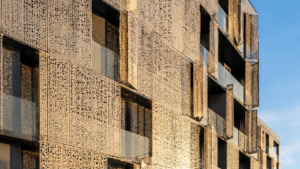
Perforated screen facades let a building tell a visual story. Custom perforation patterns can spell out logos, create geometric motifs, or simply add texture that shifts with the angle of the sun.
Shopping complexes and hospitality projects often use this as a signature design element. Because the pattern itself becomes the identity of the building, this application usually calls for the tightest tolerances and the most careful CNC perforated sheet design work in the entire project.
4. Panels for Staircases and Railings
Metal staircases and balconies often use perforated sheet in Coimbatore as infill panels instead of solid metal or glass. The holes reduce weight, allow airflow, and still meet safety requirements for enclosed edges.
5. Ceiling Panels That Reduce Noise
Perforated ceiling panels combine acoustic performance with a clean architectural finish. Paired with an absorptive backing, they help control echo in lobbies, auditoriums, and open plan offices.
6. Covers for Parking Buildings
Multi-level parking garages need constant airflow to clear out vehicle exhaust and prevent heat buildup. Perforated sheet in Coimbatore provide that ventilation while still giving the structure a finished exterior appearance.
7. Wall Panels That Absorb Sound
Sound-absorbing perforations are increasingly used inside recording studios, conference rooms, and restaurants. The perforated skin lets sound waves reach the absorptive material behind it, reducing reverberation without stripping the room of its aesthetic.
8. Signs and Directional Boards
Illuminated signage often uses perforated sheets as a backlit surface. The pattern of holes controls how light diffuses through, creating a soft glow effect that solid signage cannot replicate.
9. Privacy Screens for Balconies
Homeowners and developers use perforated sheets on balconies to add privacy without blocking airflow or natural light entirely. This is a growing trend in dense residential developments across Coimbatore and other Tier 2 cities.
10. Art and Design on Building Walls
Some of the most striking uses of perforated sheets are purely artistic. Large scale perforated panels have been used to create murals, cultural motifs, and architectural landmarks that change appearance depending on lighting and viewing angle.
Material Types and Practical Considerations
Choosing the right perforated sheet for architectural use comes down to four factors: material, thickness, corrosion resistance, and hole pattern.
Material Options
- Mild Steel (MS): Cost effective and strong, suited for internal or protected structural applications.
- Stainless Steel (SS): The preferred choice for stainless steel perforated sheets for architecture, especially in coastal or high humidity regions where corrosion resistance matters most.
- Galvanized Iron (GI): A budget-friendly option for outdoor ventilation and semi-exposed applications.
- Aluminum: Lightweight and easy to shape, commonly used for facades, sunshades, and decorative panels where weight matters.
Thickness and Hole Patterns
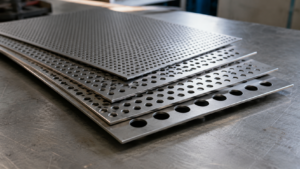
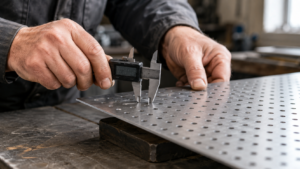
Architectural perforation typically ranges from thin decorative gauges up to heavier structural thicknesses, depending on load requirements and panel size. our perforating capacity covers sheets from 0.50mm up to 10mm, which supports everything from delicate screen facades to structural cladding.
Hole size, spacing, and open area percentage all affect how much light, air, and sound pass through a panel. A tighter pattern offers more privacy and structural strength, while a more open pattern maximizes airflow and daylight.
Corrosion Resistance and Maintenance
Outdoor architectural applications should always account for weather exposure. Stainless steel and properly treated aluminum resist rust well over time, while mild steel needs a protective coating for any exterior use.
Coastal projects deserve extra attention here. Salt air accelerates corrosion on untreated metal, so specifying corrosion-resistant perforated sheets upfront avoids costly replacement a few years down the line.
Maintenance for perforated facades is generally straightforward. Periodic cleaning to clear dust and debris from the holes keeps both the appearance and the airflow performance intact.
Most projects only need a rinse down twice a year, along with a visual inspection for any coating wear near joints or fasteners. Catching small issues early is far cheaper than repainting or replacing an entire facade panel later.
Design and Sustainability Benefits of Ventilated Facades
Perforated sheet in Coimbatore are not just a visual trend. They offer measurable sustainability advantages.
- Passive cooling reduces reliance on mechanical HVAC systems, lowering long-term energy costs.
- Daylighting through perforated screens reduces the need for artificial lighting during daytime hours.
- Material efficiency means perforated panels use less raw metal than solid cladding of the same size, since a portion of the material is removed during punching.
- Design flexibility allows architects to achieve a distinctive look without relying on expensive imported facade systems.
These benefits align well with green building rating frameworks that reward passive design strategies, a point increasingly recognized in sustainable construction guidance from bodies like the U.S. Green Building Council.
There is also a lifecycle argument worth considering. Metal panels are fully recyclable at the end of a building’s life, unlike many composite cladding materials. For architects working toward LEED or IGBC certification, specifying perforated metal panels can contribute toward material efficiency and energy performance credits, making the case to clients easier when sustainability targets are part of the brief.
Comparing Perforated Metal and Expanded Meta a complete guide
A Quick-Start Guide for Architects and Contractors
If you are specifying perforated sheet in coimbatore for an upcoming project, a few practical steps will save time and rework.
- Define the function first. Decide whether the primary goal is shading, ventilation, acoustics, or pure aesthetics. This determines hole size and open area percentage before anything else.
- Match material to environment. Coastal or high moisture sites call for stainless steel, while protected interior applications can use mild steel or aluminum.
- Request a sample panel. Before committing to a full order, ask your manufacturer for a small sample in the proposed pattern and thickness. This confirms the visual and functional performance ahead of production.
- Confirm lead times early. Custom perforation patterns and cut-to-size panels take longer to produce than standard stock sheets, so build this into your project timeline. Ordering during the design development phase, rather than waiting until construction documents are final, gives enough buffer for sampling and adjustments without delaying installation.
- Work directly with the manufacturer. Sourcing perforated metal panels directly from a manufacturer like Sudharsun Traders, rather than through multiple intermediaries, typically means better pricing, more control over specifications, and faster turnaround on custom orders.
- Plan installation details early. Fixing methods, panel joints, and edge finishing all affect how clean the final facade looks. Discuss these with your fabricator before finalizing drawings so the panel sizes account for real-world mounting constraints.
- Budget for touch-up coating. If using mild steel, factor in periodic recoating as part of the building’s maintenance plan, rather than treating it as a one-time cost at installation.
Perforated Sheet – The Material Shaping Architecture’s Future
Perforated sheet in coimbatore have moved from the factory floor to the architect’s drawing board, and for good reason. They solve real problems around heat, sound, and airflow, while giving designers a material that can be shaped into almost any visual language a project calls for.
Whether you are specifying a full ventilated facade or a single decorative screen, the right combination of material, thickness, and hole pattern makes all the difference.
Planning a facade, sunshade, or acoustic panel project? Sudharsun Traders manufactures custom perforated sheets in MS, SS, GI, and Aluminum, cut to your exact specifications. Get in touch for a free consultation and quote.