7 Key Factors to Choose Between Stainless Steel and Aluminium Perforated Sheets
Choosing between stainless steel and aluminium perforated sheets depends on more than appearance or initial price. Stainless steel vs aluminium perforated sheets is an important material selection decision because strength, corrosion resistance, weight, temperature, fabrication and maintenance requirements can vary significantly between the two.
There is no single material that is best for every application. The right choice depends on what the perforated sheet needs to withstand and how it will be used. This guide explains the key factors to consider when selecting stainless steel or aluminium perforated sheets for different industrial applications.
Stainless steel vs aluminium perforated sheets at a glance
Stainless steel and aluminium perforated sheets offer different advantages depending on the application. Stainless steel perforated sheets are generally chosen for higher strength, durability and temperature resistance, while aluminium perforated sheets are valued for their low weight, corrosion resistance in many environments and ease of fabrication.
Stainless steel can have a higher initial material cost, but its durability may make it suitable for demanding industrial applications. Aluminium can provide a useful strength-to-weight advantage while making handling and installation easier. The right choice should be based on the required perforated sheet strength, operating environment, weight, temperature, fabrication requirements and overall project cost.
Why the cheaper sheet is not always the right one
Buyers often compare the two on purchase price alone and stop there. But a sheet that corrodes early, sags under load, or needs frequent replacement is expensive no matter how cheap it looked on the invoice. The smarter comparison is total cost across the sheet’s working life, including installation, maintenance, and replacement. Sometimes that favours stainless, sometimes aluminium. The seven factors decide which.
| Factor | Stainless Steel | Aluminium |
|---|---|---|
| Strength | Generally higher strength and stiffness | Lower in many common grades, but varies by alloy |
| Weight | Heavier | Much lighter |
| Corrosion | Depends on grade and environment | Protective oxide layer; performance depends on environment |
| Initial Cost | Often higher | Often lower |
| Temperature | Generally preferred for higher-temperature applications | Strength decreases as temperature rises |
| Fabrication | Can require more demanding fabrication | Generally easier to cut and form |
| Finishing | Brushed, polished and other finishes | Anodised, coated or painted options |
Why the Cheaper Sheet Is Not Always the Right One
When comparing stainless steel vs aluminium perforated sheets, the lowest initial price may not always result in the lowest overall project cost. Material selection should consider the expected service life, maintenance requirements, fabrication, installation and replacement costs.
For some applications, aluminium may offer cost advantages because of its lower weight and easier handling. In demanding environments, stainless steel may be considered when its durability and performance can justify the higher initial material cost.
Therefore, compare the total cost over the expected service life, rather than looking only at the price per sheet. The right choice depends on the application, operating environment and long-term maintenance requirements.
Factor 1: Strength and load-bearing capacity
When perforated sheet strength is a key requirement, stainless steel is often considered for applications that need greater strength and stiffness. Compared with many commonly used aluminium grades at similar thicknesses, stainless steel perforated sheets can provide higher strength.
However, the actual load-bearing capacity of a perforated sheet depends on more than the material. Sheet thickness, hole size, open area, panel dimensions, support spacing and mounting method can all affect performance.
Aluminium perforated sheets are lighter and can offer a useful strength-to-weight advantage, but they may be more susceptible to deformation in some applications. For heavy-duty screening, guards or industrial panels, evaluate the complete sheet design and operating load before selecting the material.
For applications involving repeated or cyclic loading, the material grade, perforation pattern and stress around the holes should also be considered rather than relying on material type alone.
Factor 2: Corrosion resistance and the working environment
Corrosion resistance is an important factor when choosing between a stainless steel perforated sheet and an aluminium perforated sheet. The right material depends on the type of exposure, material grade or alloy, moisture, chemicals and maintenance conditions.
Aluminium naturally forms a thin protective oxide layer on its surface, which can help protect the material from further corrosion in many environments. Stainless steel develops a chromium-rich passive surface that provides corrosion resistance, with performance varying between different grades.
For aluminium vs stainless steel corrosion resistance, there is no single answer for every environment. Stainless steel grades such as 316 are commonly considered for applications involving chloride exposure, while aluminium can also perform well in many outdoor and general industrial applications.
Before selecting the material, consider whether the sheet will be exposed to salt water, humidity, chemicals, cleaning agents or other corrosive conditions. The specific grade or alloy, surface finish, design and maintenance requirements should all be considered.
Factor 3: Weight and ease of handling
Weight can be an important consideration when selecting a perforated metal sheet for industrial use, particularly for large panels, suspended installations or projects where transportation and installation are major factors.
An aluminium perforated sheet is significantly lighter than a stainless steel sheet of comparable dimensions and thickness. This can make aluminium easier to transport, handle and install, while also reducing the load placed on supporting structures.
A stainless steel perforated sheet is heavier, but its higher density can be suitable where strength, durability or a more substantial panel is required.
When comparing the two materials, consider the sheet dimensions, thickness, perforation pattern, open area and required support structure. These factors affect the final weight and handling requirements of the finished panel.
Aluminium’s low density makes it useful where weight reduction is important. More information about aluminium properties can help when comparing material options.
Factor 4: Cost, both upfront and lifetime
Cost is an important part of stainless steel vs aluminium perforated sheets selection, but the purchase price should not be the only consideration. The final cost of a project can also include fabrication, transportation, installation, maintenance and replacement.
Aluminium can be attractive when lower weight and easier handling help reduce fabrication or installation costs. Stainless steel may have a higher initial material cost, but it can be suitable for applications where durability, corrosion resistance or temperature performance are important requirements.
For effective perforated sheet material selection, compare the total expected cost over the service life of the application rather than comparing only the price per sheet.
When deciding between stainless steel or aluminium for perforated sheets, consider the material grade or alloy, sheet thickness, hole pattern, finish, quantity, fabrication requirements and expected operating environment. These factors can significantly affect the final quotation.
Factor 5: Temperature and fire performance
Temperature is an important consideration when selecting between a stainless steel perforated sheet and an aluminium perforated sheet. The suitable material depends on the operating temperature, exposure duration, load and specific material grade.
Stainless steel is commonly considered for applications involving higher operating temperatures because it generally retains useful mechanical properties at temperatures where aluminium can lose strength more significantly. However, actual performance varies by stainless steel grade and operating conditions.
Aluminium has good thermal conductivity, but its mechanical strength decreases as temperature increases. For applications such as ovens, exhaust systems and other high-temperature industrial equipment, the material specification should be checked against the actual operating conditions.
For fire-related applications, do not select a material based only on its melting point. The performance of the complete assembly, including thickness, supports, fixings and applicable fire-performance requirements, should also be considered.
Factor 6: Fabrication, forming, and finishing
An aluminium perforated sheet is generally easier to cut, bend and form because aluminium is lighter and softer. This can be useful when a project requires shaped panels or easier fabrication.
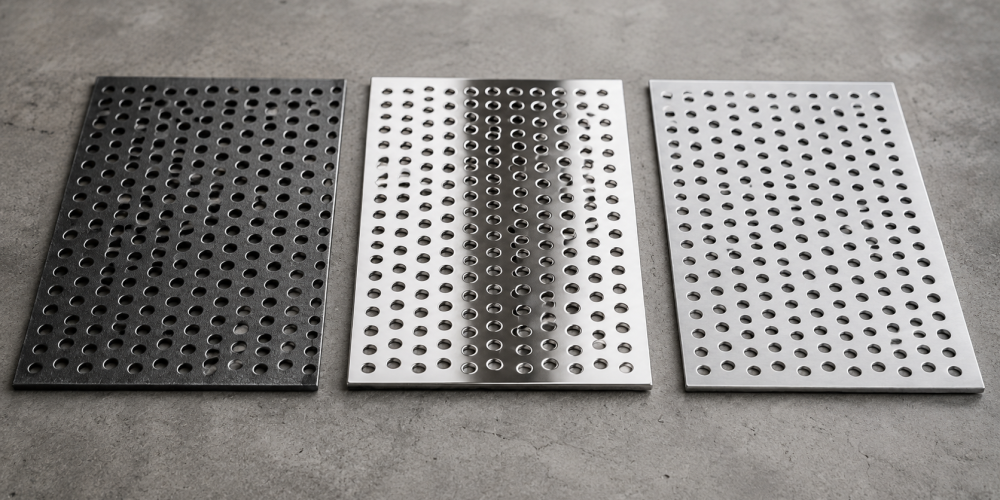
A stainless steel perforated sheet is harder and may require more robust tooling and fabrication methods. Both materials can be supplied with different finishes, so the required appearance, surface protection and fabrication process should be considered before selection.
Factor 7: Hygiene, appearance, and maintenance
A stainless steel perforated sheet is widely used in food processing, pharmaceutical and medical applications because suitable grades and finishes can support regular cleaning and sanitation.
An aluminium perforated sheet can be suitable where low weight and appearance are important. It can also be anodised, coated or painted depending on the required finish and application.
When selecting between the two, consider the cleaning process, surface finish, environmental exposure and long-term maintenance requirements.
How to Choose the Right Perforated Sheet
Need help choosing between stainless steel and aluminium perforated sheets? Sudharsun Traders can help you find suitable perforated sheet options based on your application, material, thickness, hole size and project requirements. Get the right specifications before placing your order and avoid choosing the wrong material for your application.
Have a requirement or need a quotation? Share your sheet size, material preference and quantity with Sudharsun Traders. Get in touch with the team to discuss your requirements and explore suitable perforated sheet options for your project.
Request a Quote from Sudharsun Traders